
[an excerpt from my upcoming book…]
In order to sort through the tangle of confusion caused by the western sexualization of the body, I gradually developed a tool that I call the taxonomy of touch. It is derived from study and from experience and can be used to communicate about different forms of physical intimacy.
The taxonomy of touch presented in this section has helped me process my experience of physical contact, sexual connection, and the differences between the two. The following overview explores some of the physical, spiritual, psychological, and social factors that may be at play in six unique categories of touch: sexual, erotic, sensual, affectionate, friendly, and incidental.
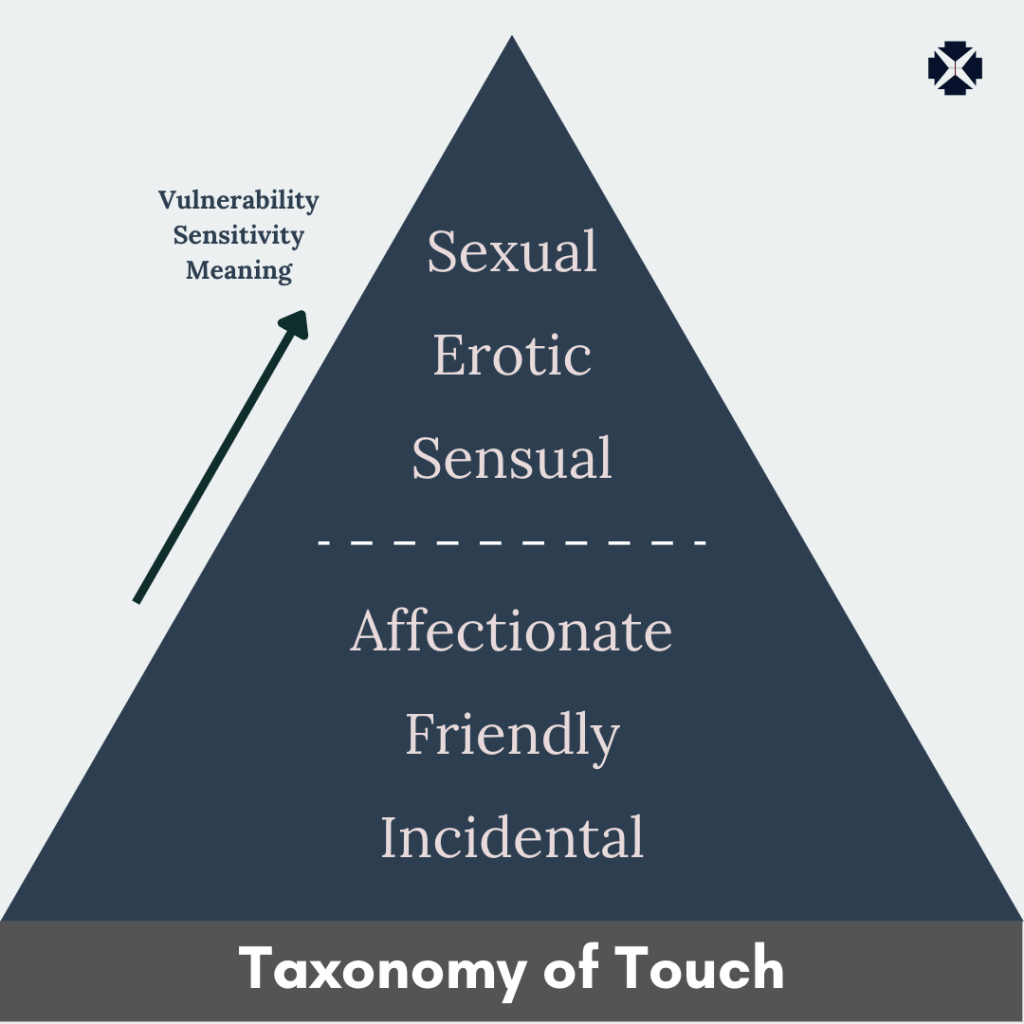
Sexual union, the most intimate and vulnerable form of human connection may be understood as an expansion of erotic energy just as erotic arousal may be understood as an expansion of sensual awakening. Each stage is an expansion of the one beneath it.
The lower stages of touch require less relational vulnerability and personal familiarity with the body. These include affectionate, friendly, and incidental touch. At the lowest level, touch remains at the periphery of the body in energetically neutral locations. As the level of intimacy increases, the location of touch tends to move toward the core of the body and include more energetically sensitive locations.
Although most people will not be skilled in their capacity to do this, it is possible to touch another person with the eyes or intention, not just with the physical body. This is where phrases like “could feel someone watching” or “hold them in your mind’s eye” come from.
Sexual Union
Sexual touch is different from all other forms of touch because it has an automatic function of intimacy, represented by its biological potential for creating life. Children are often conceived unexpectedly, and lovers blend their thinking, social reputations, spiritual state, emotions, and physical health in ways that are not always intentional. Even without awareness of what is happening, a person who opens the core of their being to another through sex will always experience some form of union with long-lasting implications.
For this reason, I believe that love is a prerequisite for a healthy sexual dynamic (though it may not be necessary to enjoy the pleasures of eros or sensuality). The next chapters examine this idea more closely. For now, it is enough to suggest that the implications of sexual union are entirely different from all the others in this taxonomy because sexual touch has great capacity to bring about a profound experience of oneness. Children represent only the biological possibility of this all-encompassing mystery.
I will not described what sexual touch looks like here because it can vary for every person and because it is the subject of the rest of this book. Furthermore, the next chapters will suggest that deep and intimate experiences of union with another do not necessarily require physical contact. Likewise, pleasurable physical connection may be the extent of what some people experience in sex. However, for purposes of sacred sexuality, the non-biological aspects of the human sexual connection may deserve greater emphasis and study.
Erotic Arousal
The link between sexual and erotic touch has been passed down to western culture through the Greek language, which blended romance, sex, and chaos together in a single word: eros, which also meant love. Eros was a potentially destructive passion that could be channeled through control of the sexual desire, intentional love, and self-control. Those who could not respond to eros in a healthy way might be accused of porneia (a term that will appear again in my discussion of sexual immorality).
Apart from those who participate in BDSM or kink communities, I have rarely met a person who can distinguish between erotic and sexual touch. This is unfortunate because sex is so much more than a wild blinding rush of erotic pleasure. On the other hand, sex without the passion of eros is not quite as exciting, so the relationship between the two kinds of touch is significant – even when sharing touch with oneself instead of with a partner.
In contrast with sensual touch, both sexual and erotic touch focus their attention and energy outward on the experience of external activation. Eros is the tension in the air between two fingertips, the moment right before the lips touch, the anticipation of pleasure, the whisper of a breath, the intensity of locked eyes, the drip of hot wax from a sensual candle. The moment right before…
The cliffhanger of erotic energy is present in war as well as in love-making and it has capacity to swallow up the world in a rage of desire. The thrilling experience of erotic touch or of highly charged energy can activate arousal for people of any gender. However, eros can be most fully enjoyed by those who are able to control the urge to use up the energy in pursuit of an orgasm.
Eros has a reputation for being chaotic and untamable which makes some level of trust in one’s partner necessary for individuals to access the full potential of erotic touch. Strong communication skills and a foundation in sensual embodiment are also key to creating a positive experience of erotic energy. Navigating erotic touch can be very confusing for someone who is not already sensitive to their own body, its likes, dislikes, feelings of pleasure, pain, pressure, movement, attraction, and so on. The inability to experience touch in a way that is safe and enjoyable keeps most people from playing with erotic arousal unless they also want to share a sexual union.
Sensual Awakening
Sensual touch, as the name implies, refers to the senses. I like to think of sensuality as sensitivity to the body, its internal state, and surroundings. This awareness can expand to include all points where the nervous system touches the outside world. Cuddly humans, soft blankets, scented candles, the glow of a dimmed lamp, the feeling of words on the tongue, a kiss, a massage, even a hug can all fall into the category of sensuality through which the body is awakened to pleasure in the surrounding physical world.
In contrast with sexual and erotic touch, which focus outward on the arousal or movement of energy, the focus of sensual touch is inward, on how the body is experiencing a physical sensation. The emphasis is never on the blanket, the candle, the lamp, or on the partner’s body, but on the sensations they awaken in one’s own body.
I suspect that orgasm is the body’s response to a sensory overload, and that the ability to carry an increased level of pleasure sensation may translate to a more profound and sustained climax. At the same time, an increase in sensitivity to one’s own body may lower the threshold to orgasm by enabling a deeper penetration of sight, sound, taste, touch, smell, movement, heat, etc. into one’s awareness. I have heard of people who go for days with subtle vibrations of orgasmic energy pulsing through their bodies. Others experience full body responses to delicious food when they allow their whole consciousness to be present with the experience of eating!
Sensual awakening is the gateway to erotic ecstasy and sexual bliss, but opening the doors to this level of sensitivity and vulnerability is only possible in a context of safety. Deep sensation requires a deactivation of the sympathetic nervous system to allow sustained and focused engagement. Sensual awakening without safety might only bring an awareness of suffering (which is itself a sensation that might be embraced…but that is for another book). Fear of harm redirects the body’s capacity toward self-preservation, heightening specific sensations and involuntary responses that mostly fall into the category of erotic touch (chaotic and external rather than present and embodied).
Because sensuality is a physical experience, it necessarily builds on prior experiences of the body. Sensations that engulf the consciousness through an external invasion leave as much of a mark as those that are welcomed through internal invitation. Those who have experienced trauma around touch may find that erotic arousal comes more easily than sensual awakening, though their response to eros may feel uncontrollable. They might also find certain parts of their body lack the sensations that lead to ecstasy and bliss. I think it is partly for this reason that many people struggle to embrace sensual touch as anything other than foreplay – or with anyone other than a trusted partner. For many of us, the ability to soak in the experience of the senses has been blunted by trauma and the lack of safe spaces for learning how to drink in the richness of life together.
Those who are unpracticed in sensuality may find it easiest to open the doors of sensation alone or with an experienced partner in a safe context. My own experience of sensual awakening was greatly supported by an incredible cuddle party facilitator. Guided practices and links to other resources (like somatic therapy to rewire the body’s neural pathways) are available on my website.
The Line That Shall NOT Be Crossed – “you shall not pass!”
Affectionate Communication
Between sensual and affectionate touch is a line that cannot be crossed without great difficulty by those who lack a healthy view of the human body – their own, and others. Many people in the church do not have the capacity to share sensual, erotic, or sexual touch with anyone besides a committed partner without a violation of their conscience. The violation of conscience may be real, but I don’t think it is necessary. The line has been drawn by centuries of toxic relationships and a misunderstanding of scripture that I will explore further in the section, “Married not Moral”
Because of confusion around the value and meaning of touch, the borders between affection and sensuality are seldom crossed (though they could be – and I think should be) unless there is a sexual interest. Affection may be present in all kinds of physical contact, including sex. However, sex does not always include affection, nor is sexual activity an appropriate expression of affection between most people.
The distinction between sensual and affectionate touch may be seen in the experience of a hug. Sensual hugs might look like a deep and long-lasting press of one body into another with an appreciation for the openness and intimacy shared by both partners. If the hands move it is often to rub or massage or pull the other person closer.
In contrast, affectionate hugs seldom last longer than a few seconds and make contact with less than half of the body. The feet are positioned at a distance from each other, and the hands may be employed in vigorous activity like a handshake or a pat on the back to distract from the potential discomfort of physical intimacy. Their purpose is a symbolic demonstration of friendship, connection, or appreciation, not the enjoyment of touch or physical closeness on its own. Unlike sensual, erotic, or sexual touch, affection is not necessarily focused on the body’s sensation, but on its ability to exchange emotional sentiments.
In these examples I am attempting to make clear that the same touch may be affectionate, sensual, erotic, or sexual – and the difference does not just depend on body parts, but on energy, relationship, and context. A hug may be present in any level of the taxonomy: incidental hugs rarely happen but may be seen when someone trips and falls into the arms of another, friendly hugs litter the world with their lack of affection; affectionate and sensual hugs have already been described. Erotic hugs probably feel like an attempt to swallow the other person and sexual hugs accompany a profound openness and delight in the other person.
A hug is not just a hug, and this taxonomy can be useful to give language to potential meanings and experiences. It is possible to share sensual touch without a context of affection. Nevertheless, affectionate touches often include some level of sensuality, or even prolonged contact, so it is usually only shared by individuals with some level of familiarity.
Affectionate touch is successful when the other person receives the infusion of sentiment it was supposed to convey. Common examples of affection may include a caress, a kiss, a touching of foreheads, a hug…all examples of contact that one might expect to see between people who care about each other. Such care does not necessarily need to be specific – as seen in the automatic human response of cooing at babies or rocking them.
All humans are deserving of affection, though not all of them interpret affectionate touch in the same way. Furthermore, many humans do not provide a safe place for sensual awakening, which means affection is the highest risk-level of touch that can be freely shared. It is possible to maintain a high level of self-protection in the exchange of affection.
Friendly Connection
In order to describe the friendly level of touch, I must explain the idea of an energetic field that surrounds each person. Although most people cannot see this field, it can be found by standing one or two steps closer to a stranger than you normally would. When the invisible proximity bubble is invaded, it is likely that one person will step away to create distance, or speak a word of greeting supposing that the other desires contact of some sort.
Words are not necessary to convey this sense of safe (or usual) proximity but can support this process for those who are not good at communicating with energetic or body language. In contrast with affectionate touch, friendly touch communicates presence, not necessarily any particular emotion or sentiment.
Touch and presence have capacity to create a resonance between a person and their surroundings, which means a history of corresponding physical contact and goodwill is a sign that someone is welcome to enter the personal energetic bubble without raising a concern for safety. Often the only requirement for openness to this level of touch is some previous contact that was neutral or positive.
However, the touch must be consensual and aligned with the circumstance or the body begins to register a dissonance experience. Those who wish to test this may visit a skilled salesperson who takes advantage of uninvited body contact to subconsciously suggest their presence is one of safety and good intention. Friendly touch typically involves only the hands or the arms as in a handshake or fist-bump. It may also include a hug or touching of the legs or shoulders while sitting or standing beside someone. It is very easy to protect oneself physically and energetically at this level of touch unless one feels particularly vulnerable to exploitation.
Incidental Contact
The final category of touch is incidental. It has neither intention nor sentiment and does not usually move beyond the periphery of the body without activating some kind of internal alarm system. When individuals are in a crowded setting and experience close physical proximity, touch may be considered incidental, yet still come with a sense of discomfort. When there is friendship or kinship, incidental proximity can be comforting because it is a friendly touch.
Imagine riding a crowded train in a foreign country. On the one side, a stranger is pressed against your body, on the other side a friend. Chances are you will find your body leaning toward your friend and away from the stranger. We all crave familiarity.
Incidental touch is not necessarily unwelcome, however. Medical care, sports, nursery duties, and many other activities involve touch that is incidental to the circumstance and has nothing to do with friendship or affection, let alone sensuality, eroticism, or sexual contact. Nevertheless, incidental touch still depends upon culture and circumstance for its appropriateness. Whenever there is not an agreed social arrangement between individuals that permits or welcomes a particular level of physical contact, any form of touch (even if it is accidental) may be experienced by the body as a violation of individual sovereignty provoking fear, discomfort, anger, and sometimes a fight, flight, freeze, or fawn response.
For example, individuals visiting a foreign country where the personal bubble is much smaller may find it difficult to carry on a regular conversation with a local who cannot stop moving too close to their face (entering the realm of affectionate instead of just friendly contact). Sometimes predatory individuals invade the personal bubbles of people they want to control, so it is helpful to know how to recognize and navigate the context in which physical contact takes place.
Because consent and body sovereignty are such an important part of laying the context for sex (as I will define in this book), I offer several resources on my website to help you and your partner or friends develop your sense of body awareness, boundaries for physical (and spiritual, psychological, or social) contact, and communication skills like listening to your body, saying no, asking for what you want, and more.
 Adult Sex Education
Leave a comment