

I believe that history is not just a record of the past – it is a way of recognizing the value of our actions and choices in the present.
Warning: this post gets a little bit scholastic…
History is About You
The present moment in time is part of the history of women and how we choose to respond to the questions facing our culture of masculinity, femininity, and even of gender identity will shape the story of the future.
History is happening right now – and it is not just taking the form of great movements, nations, and leaders. History is created by the tiny decisions, individual choices, and life experiences of every person who is alive at the same moment.
Together, our individual choices add up to the great historical moments that get written down in books – or perhaps in our case swallowed by electronic data systems.
Women’s History and Christianity
Years of immersion in the ancient texts of Christianity and Judaism have made me intimately familiar with the role of patriarchy in shaping the life experience of women.

Unfortunately, many of the historical records from my tradition showcase a culture that was hostile and oppressive toward the feminine sex. There would have been no support for the idea of women’s history month in the Greco-Roman culture of the early church.
Writings by some of the early church father’s reflect a way of thinking that is blatantly misogynistic – from placing the burden of sin upon the woman to the famous prayer “thank you that I was not born a woman.” Though this last prayer may have simply reflected on the blessing of not having to endure the suffering of being born with a female body into a world where that automatically made you someone else’s property.
Private Property
It is fitting that women’s history month follows Black history month in the American calendar – as both groups of people suffered under abuse and oppression by people who believed it was okay to treat other humans as property that could be bought and sold.
The Bible has been used to rationalize this behavior for centuries – I think largely because its message of love and equality is hard to swallow in world where economic benefits can be derived from systematic oppression of other people.
It is much easier to serve money than it is to serve God – and humans are conditioned to embrace the perspectives we grew up with. Change (or repentance) is difficult and requires a shift in practice, not just a shift in perspective. It is still seems rare to meet a woman who does not want to “belong” to someone else, or a man who does not want to “have” a wife.
Rhetoric
The tradition is embedded into our language, and language shapes how we see and interact with the world.
The traditional association of the man as provider comes from a culture in which women were not allowed to work (except as prostitutes). And yet the expectation lingers.
My question is one of whether we are just playing a temporary game of words – or whether there is really truly a desire for humans to experience equality as children of God.
This is a message that I see embedded into the Bible just as clearly as the cultural paradigms of slavery and patriarchy that reflect the world in which it was written.
As with the present day, it is the writers, the artists, the revolutionaries who imagined and prophesied a better future. And it is up to us to decide to embody that vision or appeal to the world they critiqued to rationalize a continuation of oppression. We get to choose how to read the text.
History is Now
Most of the people who I read and learn with tend to see the world through an egalitarian framework. However, there is also an alarming number of other writers and teachers who choose to look at the Bible from another perspective.
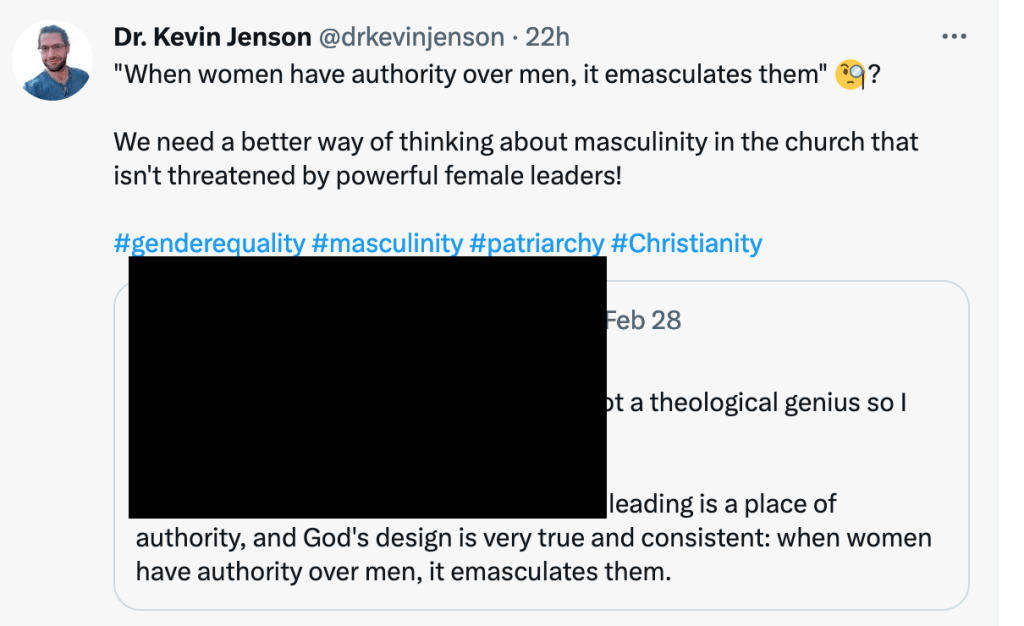
Their masculinity is threatened by the idea of equality as manhood is supposed to be the same thing as dominance. And if a man cannot dominate another person, how will he have a sense of pride in himself?
I cannot argue with the idea that people get a sense of pride from their success at shaping, crafting, and (in some sense) dominating the world around them.
But I will argue that the object of this desire is meant to be the self. Self-control, self-government, self-direction all reflect the need to rule.
However, it is often easier to satisfy this need by trying to rule another person than it is by trying to rule oneself. It is the choice of every member in a society to choose to see and relate to each other with compassion instead of with oppression.
Choice
That is why I say history is now. Each one of us has a choice to make about what to do with the legal codes, the scriptures, and the timeline we occupy in history.
The easy choice is to continue living as though oppression and dominance over someone else are a rite of passage into manhood. Or to recognize that this desire is embedded in every human being for the purpose of shaping lives that reflect the truth of love in the world.
Which history will you choose to write?
 Adult Sex Education
Leave a comment